
What "pay yourself first" means
Pay yourself first is a budgeting habit: on payday, move a fixed share of your take-home pay into savings before you pay anything else. Bills, food and fun then use what remains. Because the saving happens first, it does not depend on willpower at the end of the month, when little may be left.
The habit works best when the amount is automatic and the percentage is realistic. A smaller rate you keep for years usually beats a bigger rate you abandon after two months.
How this calculator works
Enter your monthly take-home income, the percentage you plan to save, and an assumed annual return. The calculator turns the percentage into a monthly deposit, adds it at the end of each month for 60 months, and grows the balance at a steady monthly rate that matches your annual figure. It shows two results: the total you set aside in one year, and the estimated balance after five years.
The estimate leaves out fees, taxes and inflation, and it assumes the return stays constant. Real accounts move up and down, so treat the result as arithmetic on your own assumptions, not a forecast.
A worked example
Take-home pay of $4,000 a month and a 15% savings rate means a $600 deposit each month, or $7,200 in the first year. At an assumed 5% annual return, 60 monthly deposits grow to about $40,688. With a 0% return, the same deposits simply add up to $36,000, so the assumed return accounts for roughly $4,688 of the difference.
Now compare rates. At 10% the monthly deposit is $400 and the five-year estimate at 5% is about $27,125. At 20% it is $800 and about $54,251. The estimate scales with the rate, which is why choosing a sustainable percentage matters more than chasing a high return.
Choosing a savings rate
Many budgeting guides suggest starting somewhere between 10% and 20% of take-home pay, then adjusting as your fixed costs change. If your rent and bills already take most of your income, begin with a smaller number and raise it after a raise or when a bill ends. Use the second free tool, the fixed expense check, to see how much room your budget has.
From an estimate to a routine
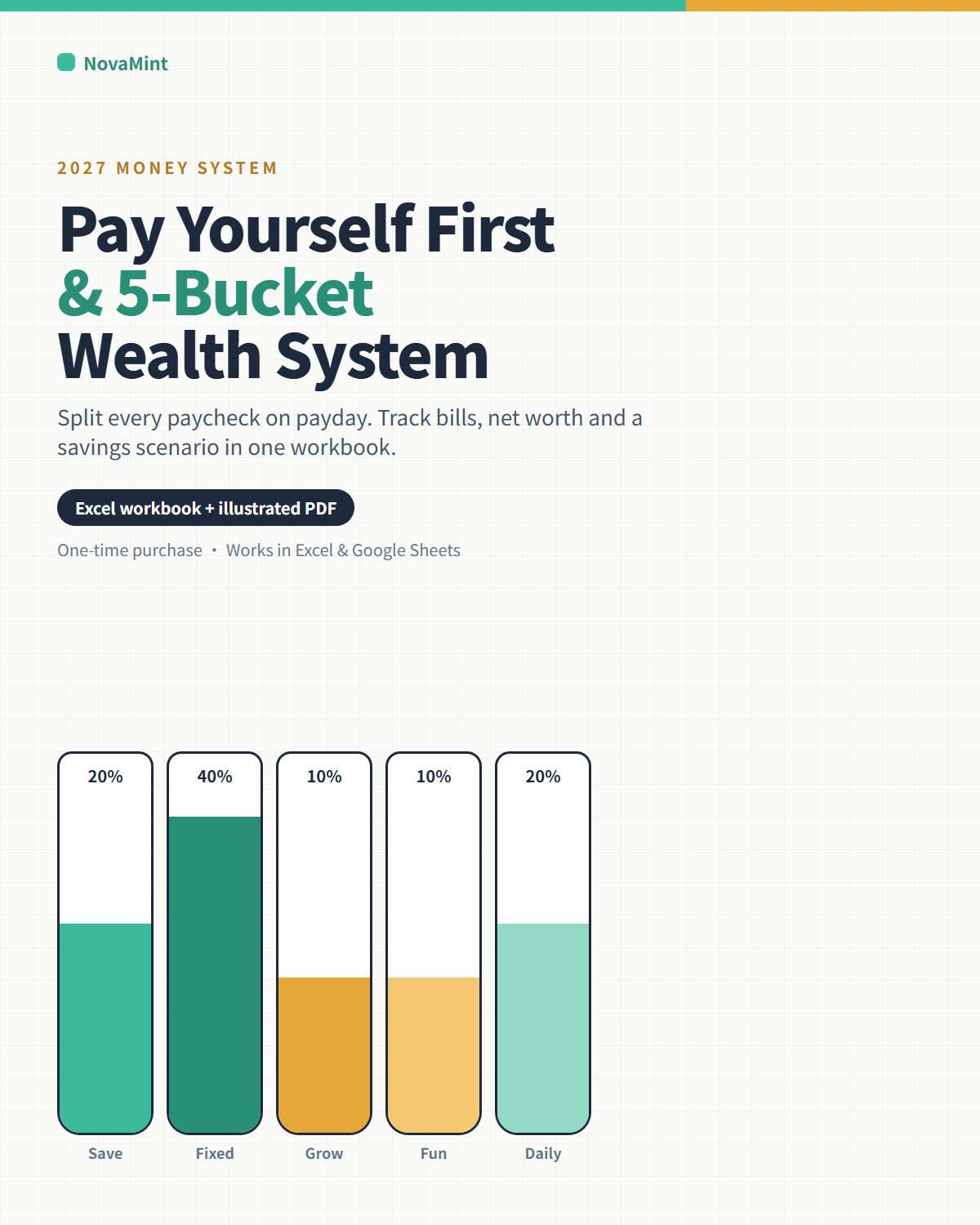
A single number is a start. A routine needs a place for every dollar. The 2027 Pay Yourself First & 5-Bucket Wealth System is a downloadable workbook that splits your income into five buckets, tracks every subscription and bill with renewal alerts, follows net worth through 2027 and shows a savings scenario you can change. You buy it once and keep it, and it opens in Excel and Google Sheets.